
PFM Dental Crowns & Bridges
American Dental Laboratory produces PFM dental crown and bridge restorations with hand-layered porcelain on non-precious, semi-precious, or white high-noble copings. From single units to long-span and Maryland bridges, every case is made in-house with a remake rate consistently below 2%.

Why PFM still earns its place
A PFM crown pairs a metal substructure with hand-layered porcelain: strength underneath, esthetics on top. The coping design flexibility is what keeps it relevant. Parafunction, limited interocclusal space, long-span bridges, and Maryland bridges are all situations where PFM’s metal core does what all-ceramic materials struggle to do.
Porcelain is layered in all 16 Vita Classical shades and 3D Master shades, plus bleach shades, so the visible surface matches the surrounding dentition.
Metal options for your PFM cases
Non-Precious
The economical choice, with dependable strength for everyday cases.
Semi-Precious
A middle path balancing cost and biocompatibility.
White High Noble
Premium copings with a lighter substructure tone that supports better porcelain esthetics near the margin.
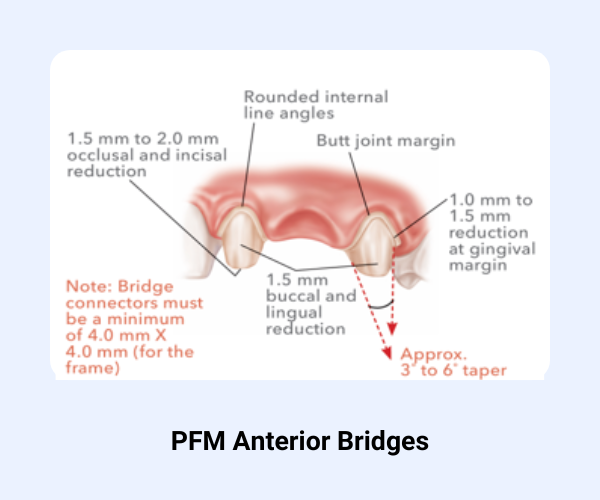
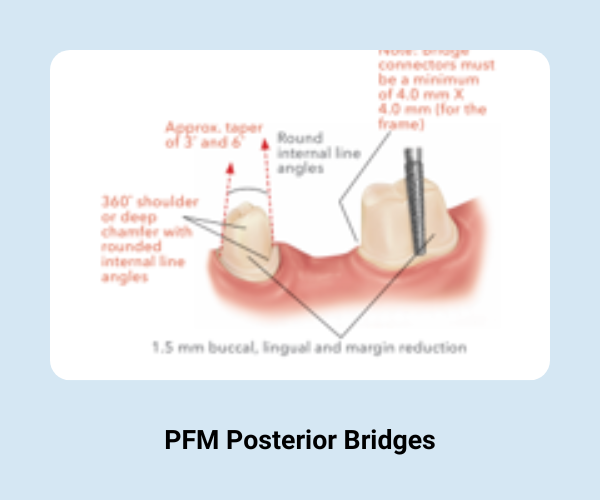
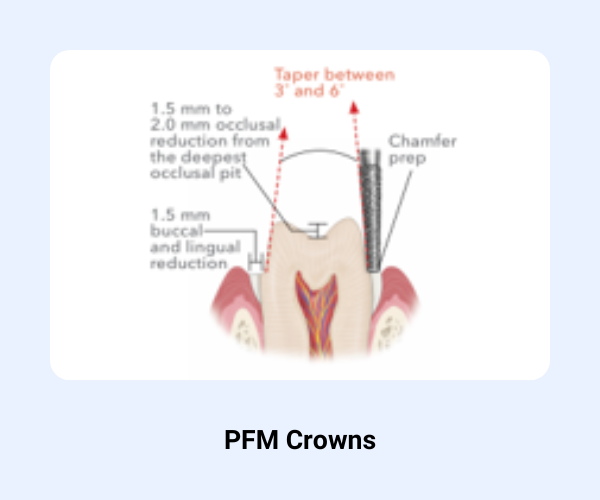
PFM crown prep dimensions & margins
Getting the prep right is most of the battle with PFM, so here are the PFM crown prep dimensions we work to:
- 1.5- 2.0 mm of occlusal reduction
- 1.5mm of incisal/inner occlusal space for optimum margin esthetics
- 0.5mm chamfer or shoulder margin preferred
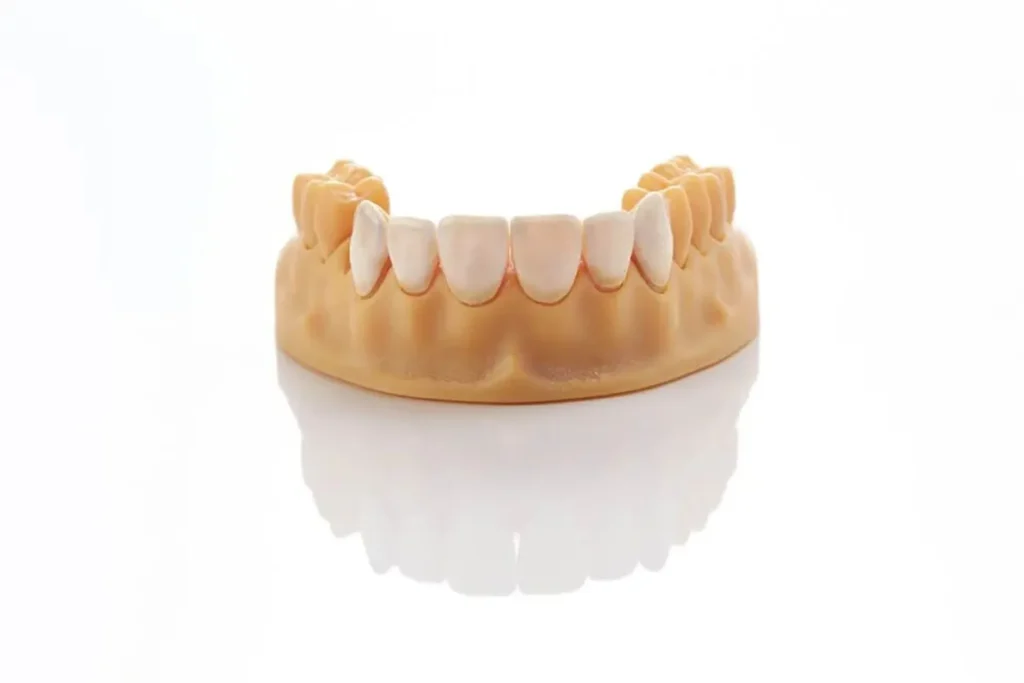
On PFM crown margins specifically: a well-defined chamfer or shoulder gives our technicians room to bring porcelain closer to the margin and keep the metal collar minimal, which is what prevents the gray line at the gumline patients complain about. Sub-gingival margin placement can hide the collar entirely in esthetic-zone cases. Questions on a specific prep? Consult our experts before you scan.
When PFM is the right choice
Three clinical situations still favor a metal framework:
Long-span bridges
The metal substructure distributes load across extended spans where monolithic ceramics carry fracture risk.
Maryland bridges:
Bonded metal wings remain the proven framework for conservative single-tooth replacement.
Limited interocclusal space:
Metal copings go thinner than any ceramic minimum, saving cases with tight clearance.
For metal-free cases, we produce zirconia bridges in the same lab, so either prescription lands with the same team.
How we build your PFM cases
Layered by Experienced Ceramists:
CDTs trained at Dawson Academy, SPEAR Education, Pankey Institute, AACD, and LVI apply the porcelain by hand.
Coping Precision:
Frameworks are designed in Exocad and 3Shape before fabrication, holding our remake rate under 2%.
Shade Collaboration:
Custom shading, staining, and treatment planning support on request.
Delivery You Can Book Against:
10 days in the lab, 98-99% on-time.
5-Year Coverage:
Materials and workmanship, warranted from completion.
Read what dentists are saying in our testimonials.

Specifications
- Indications: Single-unit crowns, long-span bridges, and Maryland bridges
- Construction: Layered porcelain on a metal core.
- Porcelain Strength: 111 MPa flexural strength on the layered surface
- Coping Choices: Non-precious, semi-precious, or white high noble
- Shade System: 16 Vita Classical shades and 3D Master shades, plus bleach shades
- Cementation: Conventional
- Warranty: 5 years
- Turnaround: 10 days in the lab
- 100–120 MPa
Request a Starter Kit

Sending a PFM Case
- Prep & Impress: Follow the prep dimensions above; scan digitally or take a traditional impression with download our Rx form.
- Choose the Coping: Mark non-precious, semi-precious, or white high noble on the Rx.
- Framework & Layering: We design in Exocad and 3Shape, fabricate the coping, and hand-layer the porcelain in-house.
- QC & Ship: A CDT verifies margins, occlusion, and shade, then your case ships on schedule via our portal.
The Restoration That's Seen It All
A restoration with proven clinical history, made by one dependable lab. Send a case or request a free starter kit and put our PFM work to the test.
Frequently Asked Questions
On a PFM crown X-ray, the metal core appears radiopaque (bright white), so recurrent decay is diagnosed at the margins.
PFM crowns are billed by substructure: D2750 (porcelain fused to high noble metal), D2751 (base metal), and D2752 (noble metal). By comparison, the all-ceramic crown dental code is D2740.
Yes. The ceramic crown code D2740 covers all-ceramic and porcelain crowns like zirconia and e.max, while PFM uses the D2750-D2752 series depending on the metal.
When a conservative, minimal-prep replacement is needed, often for a single missing anterior tooth in a young patient. PFM's bonded metal wings make it a proven framework for this indication.
Often, yes. The metal coping can be made thinner than ceramic minimums allow, which is why PFM remains a go-to for limited interocclusal space. Send the scan, and we will confirm feasibility before fabrication.