
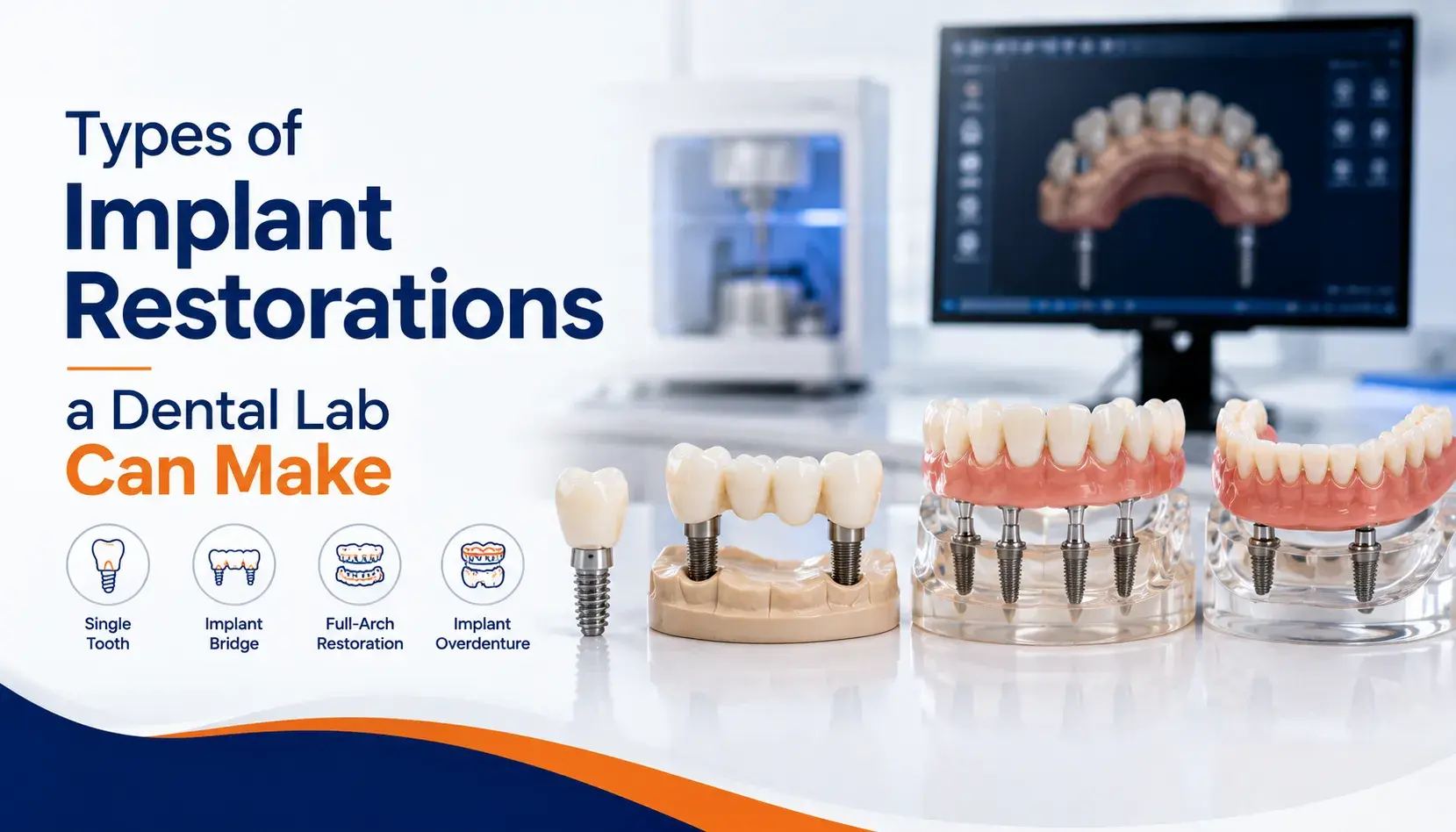
A dental lab can fabricate the full range of implant restorations: single crowns on stock or custom abutments, screw-retained and cement-retained units, multi-unit bridges, fixed full-arch prostheses, and removable overdentures on bars or attachments. It also makes the supporting parts that never appear on a treatment plan, including custom healing abutments, verification jigs, and provisionals.
What varies between labs is not the catalog. It is which implant platforms they handle every week, whether their custom abuntment come out of a manufacturer-cleared workflow, and how often they call you when a case needs it.
This guide walks through every restoration type a lab can produce, the parts behind them, and the regulatory line that decides what a lab may legally mill in-house.
Implant Restorations at a Glance
- Everything a lab makes falls into three groups: single-unit, multi-unit fixed, and removable overdentures.
- The abutment is a separate regulated device from the implant. Implants sit under 21 CFR 872.3640, abutments under 21 CFR 872.3630. Both are Class II.
- FDA treats any part connected to an implant and left in the mouth longer than one hour as an abutment. That covers custom healing abutments and most provisionals.
- Custom abutments have to be produced inside the component manufacturer’s cleared digital workflow, which specifies the scanner, software, milling equipment, and materials.
- A lab can work around a lot. It cannot work around an implant placed outside the restorative envelope.
What Is an Implant Restoration?
An implant restoration is any prosthesis that attaches to an osseointegrated fixture rather than to prepared tooth structure.
That sounds like a small distinction. It changes the entire fabrication process. There is no margin to read, no die to trim, and no preparation geometry to work from. The lab is instead handed a fixed connection with defined dimensions, a screw channel that has to exit somewhere acceptable, and soft tissue that either has been shaped or has not.
Implant position dictates most of what follows. A crown on a well-placed fixture is a routine case. A crown on a fixture placed too far buccal, too shallow, or at an angle the screw channel cannot correct becomes a compromise, and that compromise gets negotiated between you and the technician.
Restorations for a Single Missing Tooth
This is the highest-volume category and the one with the most decisions packed into it.
Crown on a Stock Abutment
A prefabricated abutment from the implant manufacturer, used as supplied or lightly prepared, with a crown cemented over it.
Stock works well when tissue depth is moderate, angulation is close to ideal, the site is posterior, and the margin lands somewhere you can actually reach. Posterior units of this kind are frequently prescribed in full-contour zirconia for the strength. The catch is that stock abutments come in fixed collar heights and fixed emergence shapes. When your tissue depth falls between two available heights, the margin ends up either too deep to clean cement from or too shallow to hide.
Crown on a Custom Abutment
An abutment designed for the individual case, milled from a titanium blank or bonded to a titanium base, with margin height and emergence profile built to the tissue that is actually there.
Custom earns its cost as tissue gets deeper, as angulation drifts, and anywhere in the aesthetic zone where a lithium disilicate crown will sit over the abutment and show whatever is underneath it. The design freedom is real but bounded: the manufacturer’s cleared parameters set the ceiling, not whatever the software will let a technician draw.
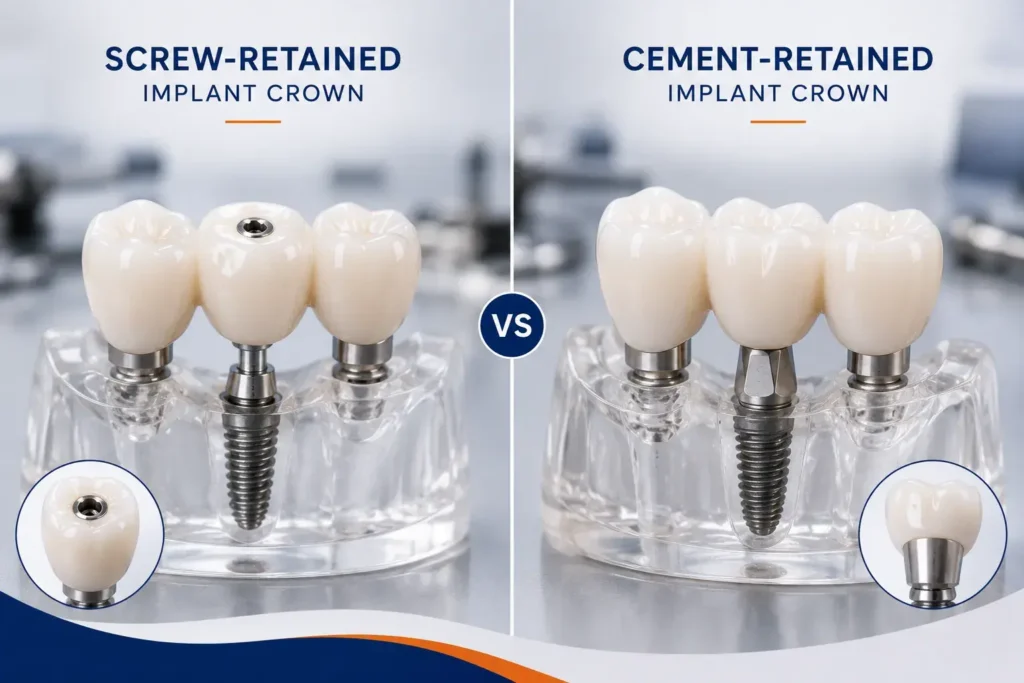
Screw-Retained Crown
The crown and the abutment interface are produced as one unit, secured directly to the implant. No cement anywhere.
Retrievability is the obvious benefit, and eliminating cement removes the residual cement problem entirely. The access hole is the constraint. In an anterior case where the channel exits through the facial, screw retention is off the table unless an angled channel can bring it back toward the cingulum.
Angled Screw Channel Crowns
A screw-retained restoration where the channel is redirected away from the implant axis, letting the screw enter lingually or occlusally instead of through the facial.
Each system publishes its own maximum correction in its clearance documentation, commonly around 25 degrees, along with a matching screwdriver angulation. The lab designs to that ceiling. If a case needs more correction than the system permits, the honest answer is a custom abutment and a cemented crown, not a workaround.
Restorations for Multiple Missing Teeth
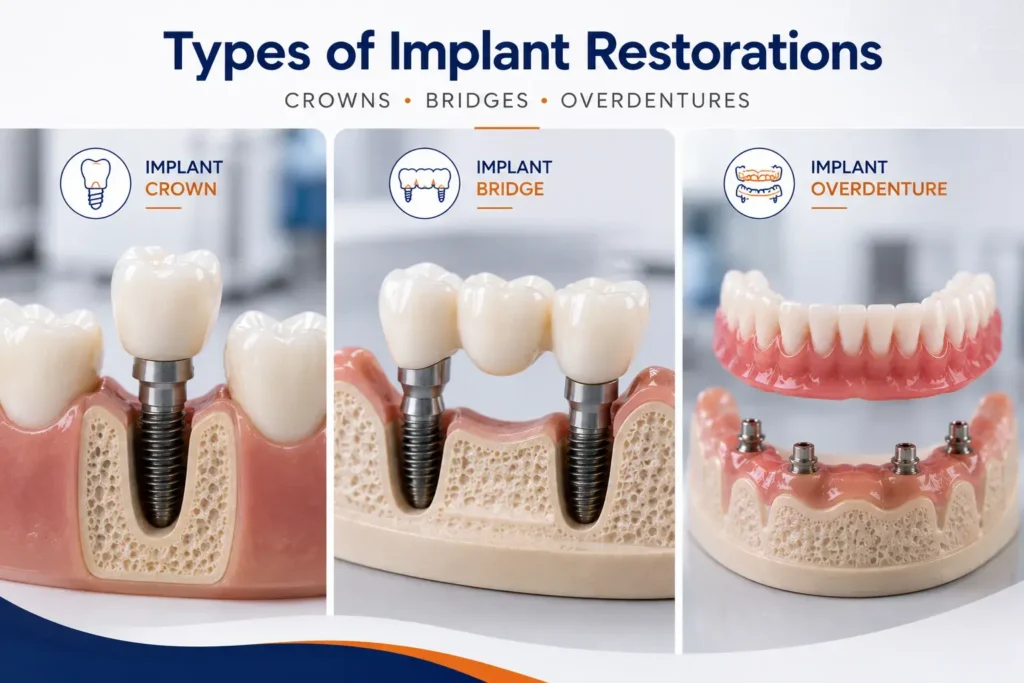
Implant-Supported Bridges
Two or more implants carrying a fixed multi-unit prosthesis, screw-retained on multi-unit abutments or cemented on custom abutments.
Passive fit is the constraint that catches people out. A bridge that seats on one implant and pulls on another transfers load into the fixtures continuously, and the patient feels nothing until something fails. This is why a verification jig is worth an extra appointment on anything spanning more than three units.
Fixed Hybrid Prostheses
A titanium bar framework carrying denture teeth in acrylic, screwed onto multiple implants in a fully edentulous arch.
Hybrids are repairable, adjustable, and forgiving of imperfect implant position. They also wear. Teeth debond over time, and the prosthesis needs maintenance appointments the patient should hear about at the start rather than at year three.
Monolithic Zirconia Full Arch
A single-milled zirconia prosthesis, screw-retained onto multi-unit abutments or titanium inserts.
Wear resistance is excellent, nothing debonds, and hygiene is easier. The trade is that zirconia is unforgiving. A fracture usually means a remake rather than a repair, and the case demands accurate records because there is no acrylic to adjust at delivery.
Choosing between hybrid and zirconia is mostly a conversation about maintenance expectations and how the patient would cope if the prosthesis had to go away for a week.
Implant Dentures the Patient Can Remove
Not every edentulous case needs a fixed prosthesis. A well-made overdenture solves problems a fixed prosthesis cannot, particularly lip support where resorption has been significant.
- Attachment-retained: A complete denture with housings engaging attachments seated on two to four implants. Retention is adjustable by swapping inserts, cleaning is straightforward, and the inserts are consumables that need periodic replacement.
- Bar-retained: A cast or milled bar splints the implants, and the removable prosthesis clips onto it. Splinting distributes load and improves retention, especially in the mandible. It costs more, needs more vertical space, and asks more of the patient’s hygiene.
Which Abutment Material to Use
| Material | Best suited to | Watch for |
| Titanium | Posterior, thick tissue, high load | Grey show-through in thin biotypes |
| Gold-hue anodised titanium | Thin tissue in the aesthetic zone | Costs more than standard titanium |
| Zirconia on a titanium base | Anterior aesthetics with a metal connection | Bond integrity depends on protocol |
| Full zirconia | Aesthetics where no metal is acceptable | Screw joint wear, posterior fracture risk |
Titanium-based construction exists for a mechanical reason. A systematic review comparing titanium and zirconia abutments found that zirconia abutments produced more severe wear, more scratching, and more rounding of the connection geometry at the implant interface than titanium abutments did. Keeping metal on metal at the connection while putting zirconia above it solves the aesthetic problem without creating a new one underneath.
Other Parts a Lab Makes
- Custom healing abutments shape the emergence profile during healing, so the final restoration is not fighting tissue that healed round.
- Verification jigs confirm passive fit before a framework is finished.
- Provisional restorations, immediate and interim, develop the transition zone before final records are taken.
- Conversion prostheses turn an existing denture into a fixed provisional at the surgical appointment.
- Screw-retained try-ins verify aesthetics and vertical dimension before anything definitive is made.
- Radiographic and duplicate prostheses support planning where the existing denture defines the target.
Fixed or Removable? A Side-By-Side Look
| Features | Fixed hybrid | Monolithic zirconia | Bar overdenture | Attachment overdenture |
| Implants typically needed | Four or more | Four or more | Four | Two to four |
| Removed by | Clinician | Clinician | Patient | Patient |
| Repairable chairside | Often | Rarely | Yes | Yes |
| Lip support from prosthesis | Limited | Limited | Good | Good |
| Hygiene demand on patient | High | Moderate | High | Moderate |
| Relative cost | Moderate | Highest | Moderate | Lowest |
What the FDA Says About Abutments?
Most lab websites skip this, and it directly affects what arrives in your office.
The implant and the abutment are two separate regulated devices. Endosseous dental implants are classified under 21 CFR 872.3640. Abutments were given their own classification under 21 CFR 872.3630 for a stated reason: abutments are not implants. Both sit in Class II.
Two consequences follow, and neither is widely understood.
The one-hour rule. FDA’s Class II special controls guidance states that any accessory connected directly to an endosseous dental implant and placed in the mouth for more than one hour is an abutment under 872.3630. Accessories contacting tissue for under an hour are exempt from 510(k) requirements.
So a custom healing abutment is an abutment in the regulatory sense. So is an implant provisional left in place through tissue maturation. These are not casual parts, and the materials used for them are not interchangeable with whatever happens to mill cleanly that day.
Custom abutments belong inside a cleared workflow. When a manufacturer obtains clearance for a titanium base or a pre-milled blank, that clearance specifies the whole production chain: which scanners, which CAD software, which milling equipment, which ceramic, which cement. A lab producing custom abutments works inside those parameters rather than substituting its own.
Turned into something you can use: ask your lab which manufacturer workflow their custom abutments are produced under. A lab that answers immediately is running a documented system. A lab that finds the question strange may not be.
As the National Association of Dental Laboratories has covered, most labs do not need their own 510(k) for the restorations they make. The exceptions tend to be labs marketing branded sleep appliances or aligners, which sit outside routine restorative work.
Details to Include on the Prescription
- Implant manufacturer, product line, platform diameter, and connection type.
- Scan body used, or the seated impression coping and analog.
- Tissue depth at the site, and whether the emergence profile was provisionalised.
- Retention preference, screw or cement, and whether an angled channel is acceptable.
- Abutment material preference, or a note asking the lab to advise.
- Opposing dentition, occlusal scheme, and any parafunction.
- Shade with photographs, plus a stump shade where a titanium base sits under a layered ceramic crown.
- Whether you want a verification jig on multi-unit cases.
Missing platform information is the most common reason an implant case stalls at intake. A lab cannot guess a connection.
Problems the Lab Can’t Design About
Worth saying plainly, because the alternative is a case that travels back and forth without resolving.
- An implant outside the restorative envelope. A fixture placed too far facially cannot be brought back without an unmaintainable ridge lap.
- Not enough interocclusal space. Screw-retained restorations need vertical room for both the channel and the material. Below a certain clearance the restoration cannot be made at safe thickness.
- An emergence profile that was never developed. Tissue that healed round can only be reshaped so far by the final restoration.
- Angulation past the system’s cleared limit. The correction ceiling comes from the clearance, not from the design software.
- A scan body that was not fully seated. The restoration then fits the recorded position rather than the real one, and nothing in the file reveals it.
Before You Send Your Next Case
The list of implant restorations a lab can make is long and fairly standard across the industry. Single crowns, bridges, fixed full arches, and overdentures are produced everywhere.
The differences that affect your cases sit underneath that list. Which platforms the lab restores weekly rather than occasionally. Whether custom abutments come out of a manufacturer-cleared workflow. Whether anyone picks up the phone when angulation exceeds what the system allows, instead of quietly designing around it.
All three are answerable. Ask before the case, not after the remake.
American Dental Laboratory has manufactured restorations in Richardson, Texas since 1986. To try us on a case, request a starter kit or send a case: 972.276.5356.
Final Thoughts
Most labs can make the same list of implant restorations. Single crowns, bridges, fixed full arches, and overdentures are standard work across the industry.
What separates them sits underneath the list: which platforms they restore weekly rather than occasionally, whether their custom abutments come out of a manufacturer-cleared workflow, and whether anyone calls you when a case exceeds what the system allows.
Those three questions are answerable. Ask them before the case, not after the remake.
American Dental Laboratory has manufactured restorations in Richardson, Texas since 1986. To discuss further, send us a case or call us at 972.276.5356.
FAQs
- What is the difference between a stock and a custom abutment?
A stock abutment is prefabricated in set sizes and emergence shapes. A custom abutment is designed for the individual case, with margin height and emergence profile built to the tissue.
- Can a lab make an implant crown without knowing the implant brand?
No. Connection geometry, component libraries, and torque values are all system-specific. Without the manufacturer, product line, and platform diameter, the case cannot be designed.
- Is screw-retained or cement-retained better?
Neither is universally better. Screw retention gives retrievability and removes residual cement risk. Cement retention handles angulation problems and avoids a visible access hole.
- Can a lab mill custom abutments in-house?
Yes, provided the work happens inside the component manufacturer’s cleared digital workflow, which specifies the scanner, design software, milling equipment, and materials.
- How many implants does a full-arch prosthesis need?
It depends on the arch, bone volume, opposing dentition, and prosthesis type. Fixed prostheses generally need more support than removable overdentures, and the surgical plan works best when the restorative outcome is decided first.