
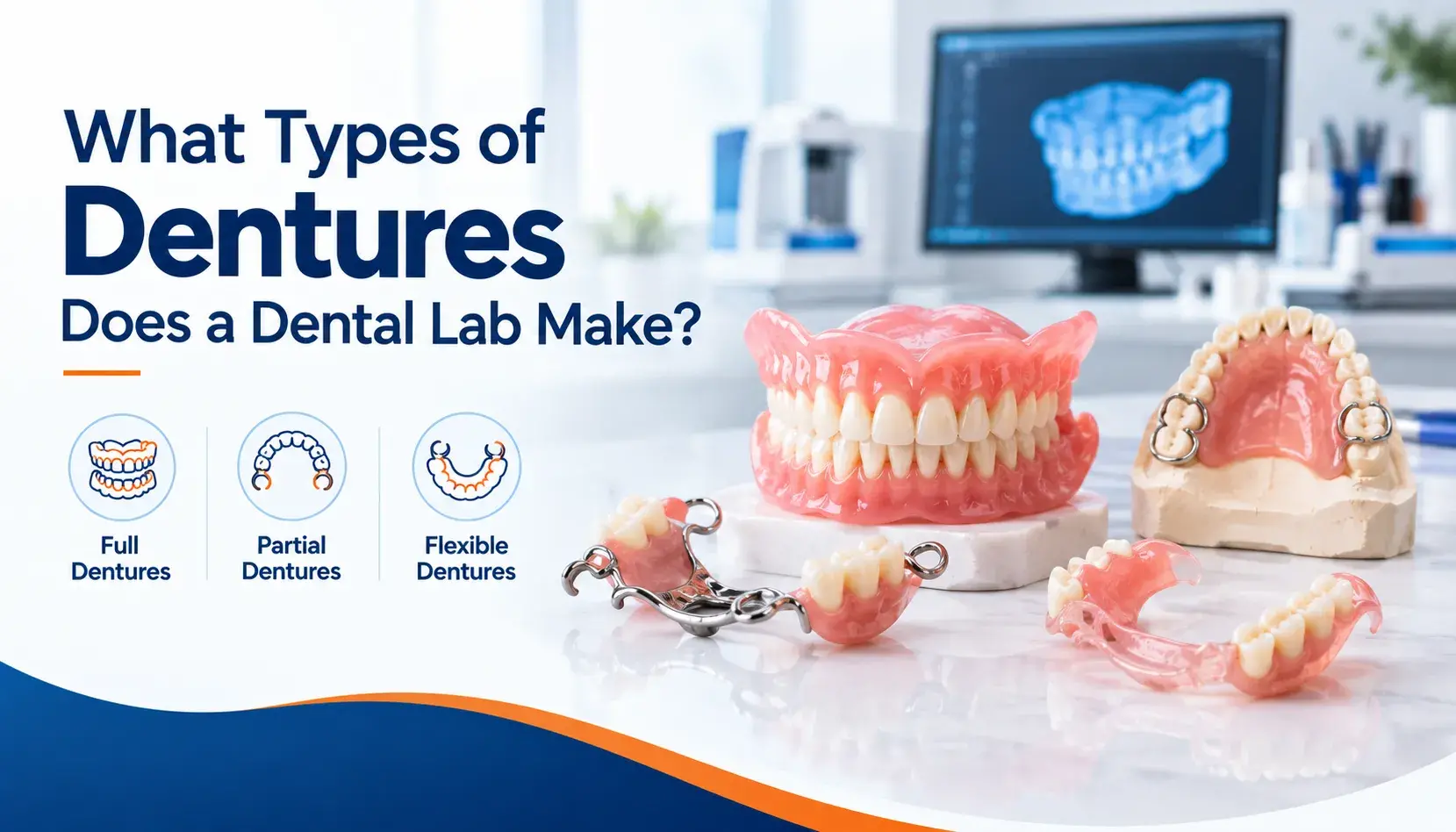
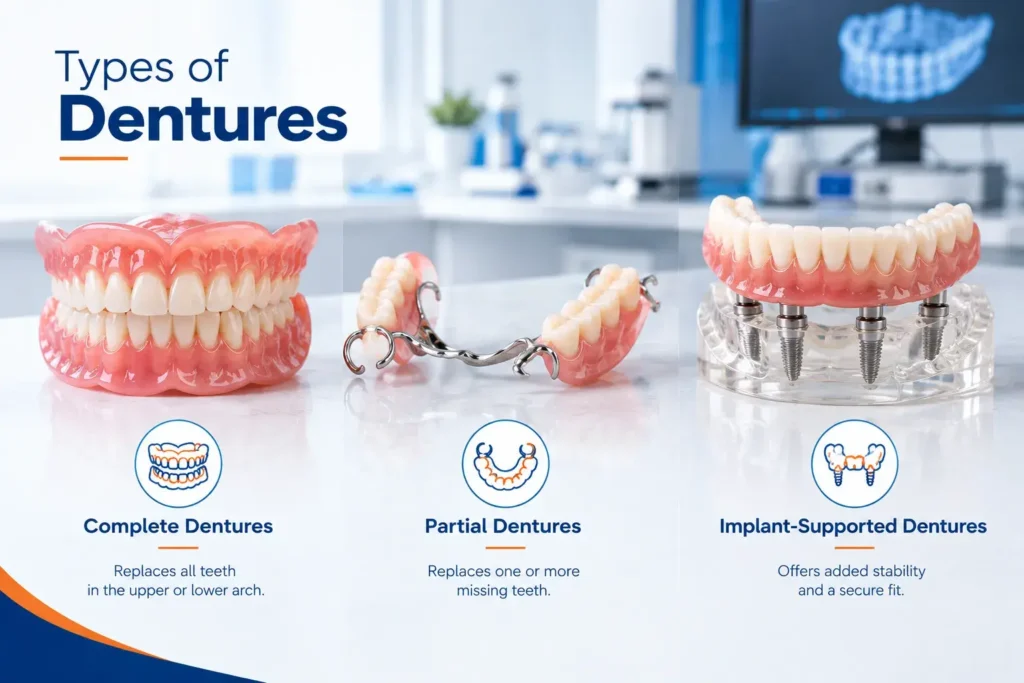
A dental lab makes three types of dentures: complete dentures for fully edentulous arches, partial dentures for patients with remaining natural teeth, and implant-supported dentures that attach to fixtures rather than resting on tissue.
Each one is a different fabrication process with a different appointment sequence and a different set of records the lab needs from you. Choosing between them is a clinical decision. Knowing what the lab does with each is what keeps the case moving.
Here is what goes into all three, how many visits each takes, and what has to arrive at every stage.
The Short Version
- Three types cover nearly every case: complete, partial, and implant-supported.
- An immediate denture is a complete denture delivered on the day of extraction, not a fourth category.
- Conventional complete dentures run to roughly five clinical visits. A fully digital workflow can cut that to two.
- Partial denture frameworks depend on rest seats and guide planes you prepare. Without them, retention gets compromised at the design stage.
- Implant-supported dentures need the platform and attachment system specified before the lab can start.
Complete Dentures
A complete denture replaces an entire arch. No natural teeth remain, so the prosthesis is supported by the ridge, the palate in the maxilla, and whatever peripheral seal the border molding achieves.
The lab work runs through a fixed sequence: preliminary model, custom tray, record base and wax rim, tooth set-up for try-in, then processing and finishing. Each stage waits on the one before it, and each depends on records you take chairside.
The part that decides the outcome is the definitive impression. Border molding captures the functional depth of the sulcus, and a denture made from an impression that stopped short of it will never seal properly no matter how well the teeth are set.
Worth building into the consultation from the start: the evidence-based denture care guidelines developed by the American College of Prosthodontists, in collaboration with the ADA Council on Scientific Affairs and the National Association of Dental Laboratories, recommend annual professional review of fit, function, and tissue health for every denture wearer. A denture is not a one-time delivery.
Immediate Dentures
An immediate denture is a complete denture fabricated before extraction and inserted the same day. It is not a separate category, just a complete denture on a compressed timeline.
The lab sets the teeth over a model where the remaining teeth have been trimmed to simulate the healed ridge. That is an educated approximation, not a measurement, and it is why immediates almost always need a reline once healing settles. Tell the patient that at the consultation rather than at the six-month mark.
Partial Dentures
A partial denture replaces some teeth while the rest remain. The design question is where support comes from, and the answer shapes everything else.
Cast metal frameworks are the durable option. A chrome-cobalt framework is surveyed, designed, and cast to engage specific undercuts, with rests transferring load onto the teeth rather than the ridge. These need framework design work before fabrication begins: path of insertion, clasp assemblies, major connector, and reciprocation.
Flexible partials use a thermoplastic base with no metal clasps. They look better in the anterior and suit patients who react to metal. They also flex under load, which means they transfer force to the tissue rather than the teeth, and they cannot be relined or adjusted the way a cast framework can.
Acrylic partials are the interim option. Fast, inexpensive, easy to add to. Not intended as a long-term prosthesis.
Where a partial borders an existing crown, tell the lab. A survey crown needs its guide plane and rest seat built in at the crown and bridge stage, not retrofitted after the fact.
The constraint worth naming: framework design depends on rest seats and guide planes you prepare. If they are not there, the lab either calls you or designs around the problem, and designing around it means accepting less retention than the case could have had.
Implant-Supported Dentures
An implant-supported denture, or overdenture, is a removable prosthesis that engages implants rather than sitting on tissue alone.
The evidence behind this is unusually settled. The McGill Consensus Statement, published in 2002 and reaffirmed by the later York Consensus, established a mandibular two-implant overdenture as the first-choice standard of care for edentulous patients.
Two retention approaches:
Attachment-retained. Housings in the denture engage attachments seated directly on the implants, usually two to four. Retention is adjustable by swapping inserts, and the inserts are consumables that need periodic replacement.
Bar-retained. A cast or milled bar splints the implants and the denture clips onto it. Splinting distributes load better and improves retention, particularly in the mandible. It costs more, needs more vertical space, and demands more from the patient’s hygiene.
Either way, the lab needs the implant manufacturer, platform diameter, and connection type before anything starts. These are system-specific components, and a lab cannot guess a connection.
Comparing the Three Types
| Complete | Partial | Implant-supported | |
| For | Fully edentulous arch | Some natural teeth remain | Edentulous arch with implants |
| Support from | Ridge and palate | Teeth and tissue | Implants |
| Retention | Peripheral seal | Clasps or attachments | Attachments or bar |
| Relinable | Yes | Cast metal yes, flexible no | Yes |
| Preparation needed | None | Rest seats, guide planes | Implant placement |
| Bone preservation | No | Partial | Yes |
How Many Appointments Each Type Takes
The conventional complete denture sequence is documented as at least five visits: preliminary impression, definitive impression, jaw relation records, try-in, and insertion. Post-insertion adjustments come on top.
A fully digital workflow can reduce that to two, and literature reviews put the average for digitally fabricated complete dentures around four visits to insertion.
| Type | Typical visits to insertion |
| Complete, conventional | 5 |
| Complete, digital | 2 to 4 |
| Immediate | 3 to 4, plus a reline later |
| Cast partial | 4 to 5, including framework try-in |
| Flexible partial | 2 to 3 |
| Implant overdenture | 4 to 5 after healing |
Treat these as the sequence, not a guarantee. Difficult ridges, aesthetic demands, and remakes all add visits.
What the Lab Needs at Each Stage
The case stalls where a record is missing. Working through the prescription in order:
- Preliminary impression: both arches, tray choice noted
- Definitive impression: border molded, full sulcus depth captured
- Jaw relations: rims with midline, high lip line, and canine positions marked, plus vertical dimension
- Tooth selection: mould, shade, and any patient preference on arrangement
- Try-in feedback: written changes to midline, lip support, or vertical, not verbal notes relayed later
- Partials specifically: surveyed model, rest seat locations, undercut preference, clasp type
- Implant cases: manufacturer, platform, connection, attachment system, tissue depth
If you are sending a case digitally for the first time, the case submission instructions cover scanner setup and file formats.
Milled, Printed or Conventionally Processed?
Three production routes, and the differences matter more than they sound.
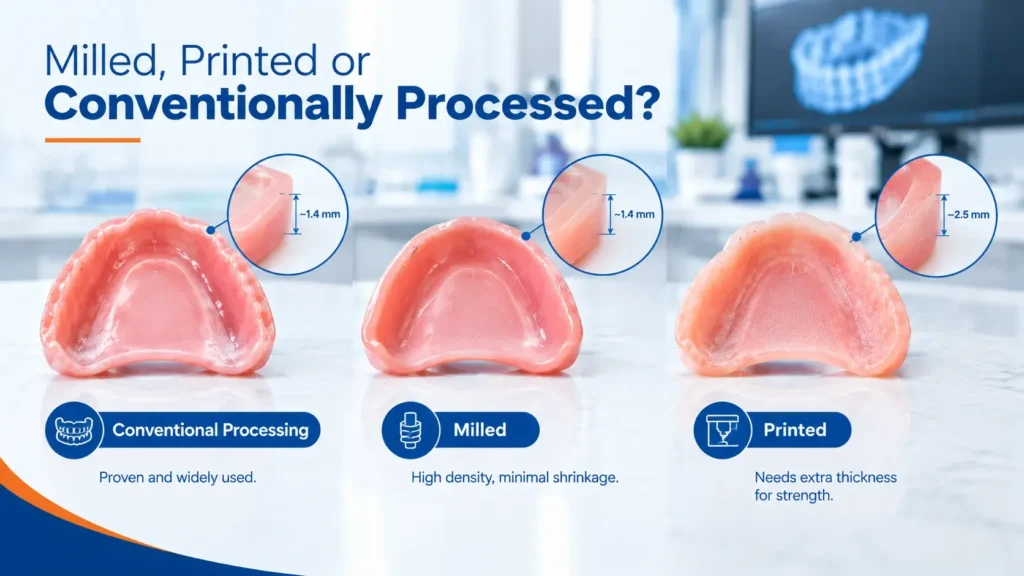
Conventional processing packs and cures acrylic against a stone mould. Proven, and still the most common route.
Milled dentures are cut from a pre-polymerized puck. Density is high and shrinkage is minimal, since the material was polymerized under controlled conditions before milling.
Printed dentures build the base additively. Fast and cheaper, but the research notes a real constraint: printed bases need a minimum thickness of around 2.5mm for adequate strength, where milled and conventional bases perform at about 1.4mm. That extra millimeter sits in the palate, and patients notice it during speech.
Choosing Between Them
Most denture decisions come down to what is left in the arch and what the patient can maintain.
Complete dentures suit fully edentulous arches where implants are not an option. Partials preserve remaining teeth and distribute load, provided the preparation supports the design. Implant-supported dentures solve the retention problem that conventional lower dentures never fully solve, which is why the consensus evidence points that way for the mandible.
The lab side of the decision is smaller but not trivial: send the records the design depends on, and specify rather than leave it open.
American Dental Laboratory has built removable prosthetics in Richardson, Texas since 1986. To talk a case through before you start it, get in touch or request a starter kit: 972.276.5356.
Questions Dentists Ask
How many types of dentures are there?
Three main types: complete, partial, and implant-supported. Immediate dentures are a complete denture delivered at extraction rather than a separate category.
What is the difference between a partial denture and a complete denture?
A complete denture replaces a full arch and rests on the ridge. A partial replaces some teeth and takes support from the remaining natural teeth through rests and clasps.
Can a flexible partial be relined?
Not reliably. Thermoplastic materials do not bond to conventional reline acrylics the way a processed acrylic base does. If a case will need relining, a cast framework is the better choice.
How often should a denture patient be reviewed?
The ACP evidence-based guidelines recommend an annual professional check of fit, function, tissue health, and bone levels. Ridges resorb whether or not the denture still feels acceptable to the patient.
Do immediate dentures always need a reline?
Almost always. The lab sets teeth over an approximated ridge, and tissue changes considerably during healing. Plan for it from the start.