
A full-service dental lab designs and manufactures every category of restoration in one facility: fixed, removable, and implant-borne. That means crown and bridge, ceramics, dentures and partials, implant components, and digital design all sit under one roof, with one point of accountability when something needs to be remade.
The problem is that “full service” is a marketing phrase, not a regulated term. Any lab can print it. Some labs mean it literally; others accept your case and quietly ship the milling, the framework, or the entire unit to a third party.
This guide covers what actually happens inside a full-service lab, how to tell the difference between labs that mean it and labs that don’t, and what to ask before you send your first case.
Key Points to Consider When Choosing a Dental Laboratory
- A full-service dental lab covers fixed, removable, and implant restorations in-house, across five core departments.
- “Full service” is not a regulated claim. It does not guarantee on-site production, support for your implant platform, or orthodontic and surgical guide work.
- Most domestic dental labs are exempt from FDA establishment registration under 21 CFR 807.65(i). A lab advertising itself as “FDA registered” is either importing, making devices outside the exemption, or stating it inaccurately.
- The credentials that carry verifiable weight are CDT (individual technician) and CDL (the laboratory), both administered by the National Board for Certification.
- The single most useful question to ask a lab: which steps happen in your building, and which don’t?
What Work Does a Dental Lab Perform?
A dental lab manufactures custom restorations to a dentist’s written prescription.
You send the case: the intraoral scan or physical impression, the shade record, the opposing model, and your instructions. The lab converts that into a physical restoration that has to seat, function under load, and match the surrounding dentition.
And it does this without ever meeting the patient.
That constraint defines the entire relationship. The lab works only from what you send. Anything you leave off the prescription becomes a judgment call made by a technician who cannot see the patient, cannot check the occlusion in person, and cannot ask the patient what they want.
This is why prescription quality correlates so directly with remake rates. It is not administrative box-ticking. It is the only channel of information the lab has.
The Dental Lab Process: From Case Submission to Delivery
Understanding the sequence helps you diagnose where a case went wrong.
- Case review and Inspection
The scan or impression is checked for margin visibility, tissue interference, distortion, and whether the prescription matches what arrived. Cases with unreadable margins get flagged here, or they should.
- Digital design or modern work
For digital cases, the file moves into design software such as exocad or 3Shape. For analog cases, models are poured, dies are sectioned and trimmed, and the case is articulated.
- Substructure fabrication
Milling, casting, or printing, depending on material. Zirconia is milled oversized and sintered, since it shrinks predictably during firing. Cast alloys are waxed, invested, and cast.
- Ceramics and finishing
Layering, staining, glazing, and shade characterization. This is where a technically accurate restoration either becomes an aesthetic match or doesn’t.
- Quality Control and Dispatch
Fit verified on the model, contacts and occlusion checked, surface finish inspected, case documented and shipped.
The handoffs between these stages cost more time than the stages themselves. A crown that goes to ceramics, returns for a contact adjustment, then goes back for a re-glaze has been handled three times. That’s where turnaround days disappear, and it’s why a lab running all five stages in one building has a structural time advantage over one coordinating vendors.
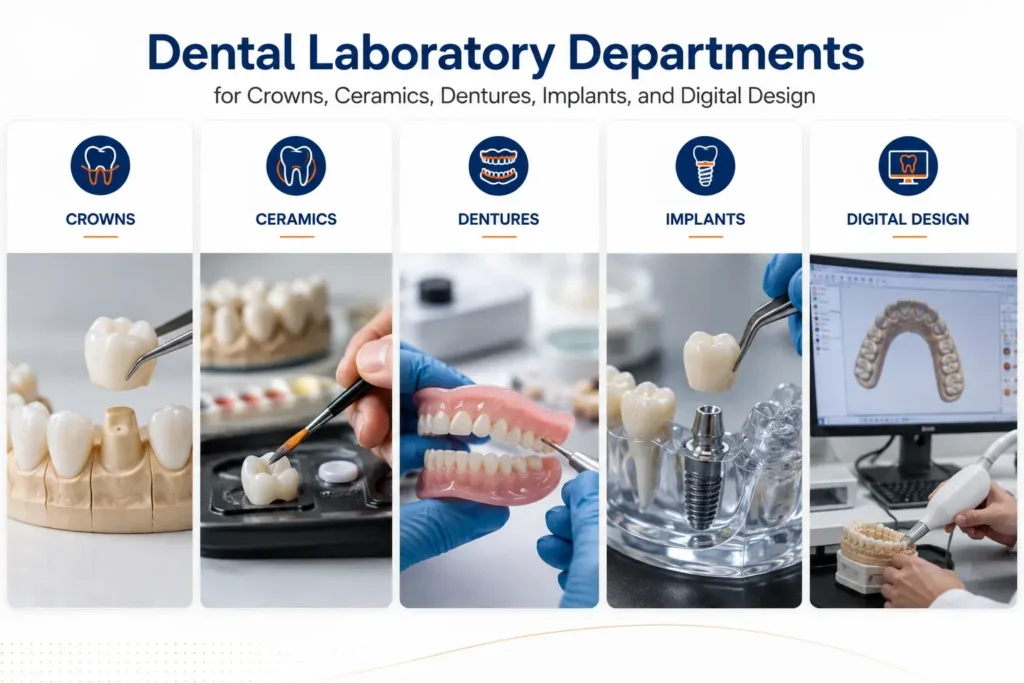
Departments in a Full-Service Dental Lab
Crown and Bridge
What it covers: single crowns, multi-unit bridges, inlays, onlays, and full-cast units.
This is the volume department in almost every lab. The technical work is reading and marking margins, trimming dies, establishing proximal contacts and occlusal scheme, and sizing connectors on anything spanning an edentulous site.
Why it matters to you: connector dimension is the most common cause of bridge fracture, and it’s determined entirely by the space your preparation leaves. A lab that calls you about inadequate connector space is protecting the case. A lab that silently makes it anyway is not.
Ceramics
What it covers: layering, staining, glazing, and shade characterization on layered restorations and monolithic units.
This department separates good labs from average ones, because it’s the only one where the output is judged by eye rather than measured for fit. Matching a single central incisor to the natural tooth beside it is a skill, not a process, and no mill performs it unassisted.
Why it matters to you: if a lab outsources ceramics, your anterior aesthetic cases are being finished by someone you cannot call.
Removable Prosthetics
What it covers: complete dentures, cast and flexible partial frameworks, relines, rebases, and repairs.
Cast metal partials require surveying and framework design before any fabrication begins. The lab determines path of insertion, undercut engagement, clasp design, and major connector.
Why it matters to you: framework design depends on rest seats you prepare. If they aren’t there, the lab either calls you or designs around it, and designing around it usually means compromising retention.
Implant Restorative
What it covers: custom abutments, screw-retained and cement-retained crowns, bars, and hybrid prostheses. Implant restorative work carries the most system-specific knowledge of any department.
Every implant manufacturer maintains its own connection geometry, component library, and torque specification. A lab restoring a platform it doesn’t routinely handle is working from a library file rather than experience.
Why it matters to you: ask which systems a lab restores regularly, not which ones it can order components for. Those are different answers.
Digital Design and CAD/CAM
What it covers: scan intake, design in exocad or 3Shape, nesting, milling, and sintering.
In a genuine full-service lab, this is not a separate business line. It feeds the other four departments, whether the case finishes as monolithic zirconia, a layered PFZ unit, or a cast framework.
Why it matters to you: a lab whose digital department exists only to mill posterior monolithic crowns is a milling operation with extra departments attached, not an integrated workflow.
Understanding the Limits of a Full-Service Dental Lab
More than most lab websites admit. Full-service describes the range of restoration types offered. It does not automatically mean:
- Everything is made on site: Some labs accept the case and send milling, frameworks, or complete units to a production center, sometimes offshore. Your invoice still shows one lab name.
- Every implant system is supported: Component access varies. A lab can be genuinely full-service and still not carry your platform’s library.
- Orthodontic appliances are included: Aligners, retainers, and expanders are a separate discipline. Many restorative labs don’t make them at all.
- Surgical guides are included: Guide design is a different workflow with different planning software and different liability.
- Sleep and airway appliances are included: These fall outside the routine restorative scope, and they also sit outside the FDA registration exemption discussed below.
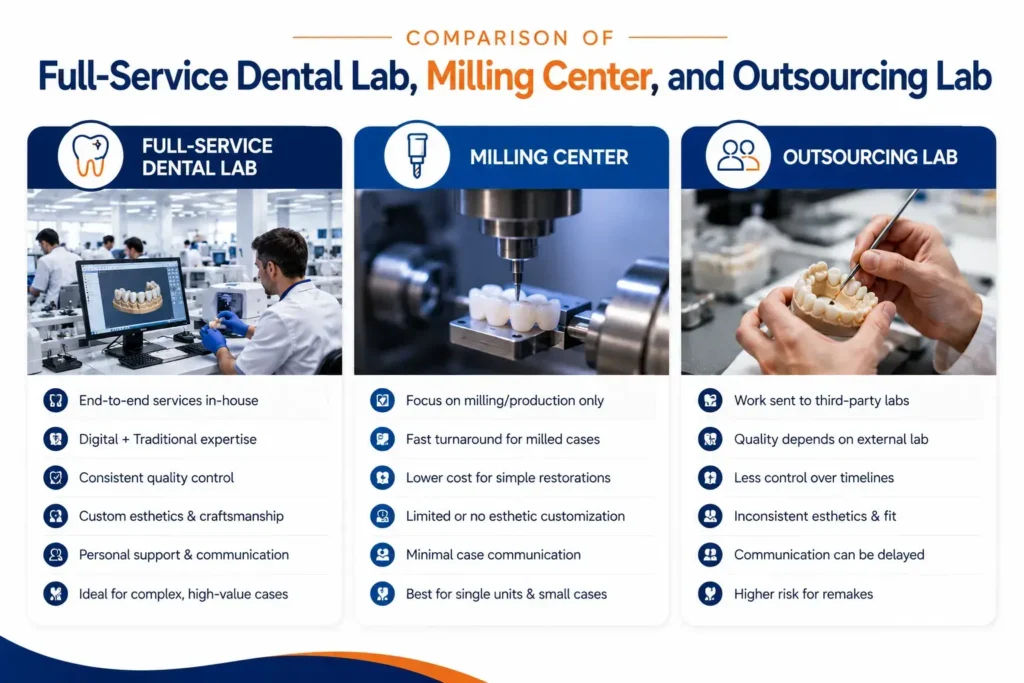
Full-Service Lab vs Milling Center vs Outsourcing Lab
| Features | Full-Service Lab | Milling Center | Outsourcing Lab |
| What they make | Fixed, removable, implant | Fixed, mostly monolithic | Sold as full range |
| Who designs it | In-house technicians | Often your own file | A third party |
| Ceramics work | In house | Limited or none | A third party |
| Who you call | The technician who made it | Order support | Sales, not the maker |
| Remake accountability | One place | Split | Unclear |
| Typical turnaround driver | Internal scheduling | Mill queue | Vendor transit |
| Best for | Complex, aesthetic, mixed cases | High-volume posterior units | Price-driven volume |
None of these models is wrong. A milling center is a sound choice for straightforward posterior monolithic crowns at volume, and often cheaper. Problems start when anterior aesthetic work or complex implant cases get routed to a facility built for throughput.
How to Choose the Right Dental Laboratory
Use this framework rather than relying on how a lab describes itself.
Check what is made on site
Why it matters: outsourced production adds transit time, removes your access to the person who made the restoration, and makes remake diagnosis harder.
What to do:
- Ask directly which processes happen in the building
- Ask whether any production is sent offshore
- Ask to visit, or request a virtual walkthrough
Red flag: a lab that answers this vaguely, or reframes it as “we work with trusted partners.”
Check Technician Certification
Why it matters: dental technology is not a licensed profession in most states. Certification is voluntary, which makes it a genuine differentiator rather than a baseline.
What to do:
- Ask how many Certified Dental Technicians are on staff and in which specialty areas
- Ask whether the laboratory itself holds CDL certifications
- Verify names independently rather than accepting a logo
Red flag: certification claimed at company level with no named individuals behind it.
Check Implant system coverage
Why it matters: component libraries, connection geometry, and torque values are system-specific.
What to do:
- Provide your actual platform list and ask which are restored routinely
- Ask whether original manufacturer components or third-party alternatives are used
- Ask how scan bodies are handled
Red flag: “we can do any system.” Ordering a component and knowing a platform are different things.
Check how remakes are handled
Why it matters: the remake policy tells you how the lab thinks about accountability.
What to do:
- Ask what the policy covers and for how long
- Ask whether a remake analysis is provided
- Ask who makes the call when fault is unclear
Red flag: a policy that exists but has no written terms.
Check communication access
Why it matters: most case problems are solved faster by a two-minute conversation than by a remake.
What to do:
- Ask whether you can speak to the technician who made the case
- Ask what happens when a prescription is unclear at intake
Red flag: all contact routed through a sales representative.
Questions to Ask Before Choosing a Dental Lab
- Which processes happen in your building, and which are outsourced?
- Is any production sent offshore?
- How many CDTs are on staff, and in which specialties?
- Is the laboratory CDL certified?
- Which implant platforms do you restore weekly?
- Do you use original manufacturer components?
- What is your remake policy in writing?
- What is your average turnaround for my most common case type?
- Will you call me if the prescription or preparation has a problem?
- Which scanners and file formats do you accept?
Is Your Dental Laboratory FDA Registered?
Usually not. And a lab claiming otherwise is worth a follow-up question.
Dental devices are classified under 21 CFR Part 872, which covers roughly 130 generic categories of dental devices. But domestic dental laboratories are specifically exempt from establishment registration under 21 CFR 807.65(i). That provision exempts personnel from a dental laboratory whose primary responsibility is providing a service through the use of a previously manufactured device.
So when a lab website advertises “FDA registered,” one of three things is true:
- They import devices. Importers do register.
- They make something outside the exemption, such as a sleep apnea appliance or snore guard.
- The claim is not accurate.
The exemption does not remove the lab’s obligation to manufacture correctly, to your prescription, using materials cleared for the indication. The National Association of Dental Laboratories has worked through these boundaries directly with FDA, including where CAD/CAM abutment workflows fall.
Why this matters to you: the restoration is made to order on your written prescription. You are the prescriber. The lab manufactures to your instruction. That is a genuine division of responsibility, and it is the practical reason a vague prescription creates more than an inconvenience.
Dental Lab Certifications: CDT and CDL Explained
Dental technology is unregulated in most states, so certification is the only independently verifiable quality signal available to you.
| Features | CDT | CDL |
| Applies to | An individual technician | The laboratory facility |
| Administered by | National Board for Certification | National Board for Certification |
| Scope | Certified by specialty area | Facility-wide standards |
| Covers | Technical knowledge and applied skill | Quality assurance, safety, infection control, case management, billing and rework policy |
| Requires | Examination, ongoing continuing education | At least one CDT of record on staff |
The National Board for Certification was founded in 1955 by NADL and operates as an independent certifying body. It reports over 5,500 active CDTs and roughly 200 certified laboratories. NBC is the only organization recognized by the American Dental Association for certifying dental laboratory technicians.
Mistakes to Avoid When Choosing a Dental Laboratory
- Choosing on unit price alone: A remake costs a rescheduled appointment, chair time, and patient confidence. Those exceed the price difference quickly.
- Assuming full-service means on-site: It doesn’t, and the two are routinely conflated.
- Not matching the lab to the case type: Sending complex anterior aesthetics to a volume operation is a mismatch, not a lab failure.
- Skipping the trial case: One case on a straightforward unit tells you more than any brochure.
- Leaving material selection to the lab: A good lab will call when the prescription and available clearance disagree, but the choice is a clinical decision, and it belongs to you.
- Treating the prescription as paperwork: It’s the only information channel the lab has.
Case Submission Requirements
- Accurate scan or impression with fully visible margins.
- Opposing arch and bite registration.
- Shade with photographs, taken before the tooth dehydrates.
- Material specified, not left open.
- Occlusal scheme and contact preference.
- Preparation design notes where anything is unusual.
- Return date and any patient scheduling constraints.
- Implant system, platform, and connection where relevant.
The Final Thoughts
“Full-service” describes what a laboratory offers. It does not describe what a laboratory does.
The distinction matters because the term carries no regulatory weight and no verification behind it. Two labs can use the same phrase while one manufactures everything in a single building and the other functions as a coordinator between vendors you will never speak to.
American Dental Laboratory has manufactured restorations in Richardson, Texas since 1986, with fixed, removable, implant, and digital work in-house. To see how a case is handled end to end, request a starter kit or send a case: 972.276.5356.
FAQs
What is the difference between a dental lab and a dental technician?
The lab is the facility. The technician is the person. A Certified Dental Technician has passed an examination through the National Board for Certification in Dental Laboratory Technology, which certifies by specialty area rather than across the board.
Does a full-service lab handle its own remakes?
It should, and that’s a large part of the value. When design, milling, and ceramics all happen in one building, there is a single point of accountability.
Can a lab work with any intraoral scanner?
Most labs accept the common open file formats. The constraint is usually the export setting rather than the scanner brand. Send a test case before committing patient time.
Do I need to specify the material, or will the lab pick?
Specify it. A good lab will call you when the prescription and available clearance don’t match, but material selection is a clinical decision, and it belongs to you.
How long should a crown take at the lab?
It varies by material and complexity. What matters more than the headline number is whether the lab quotes turnaround for your specific case type and then meets it consistently.