
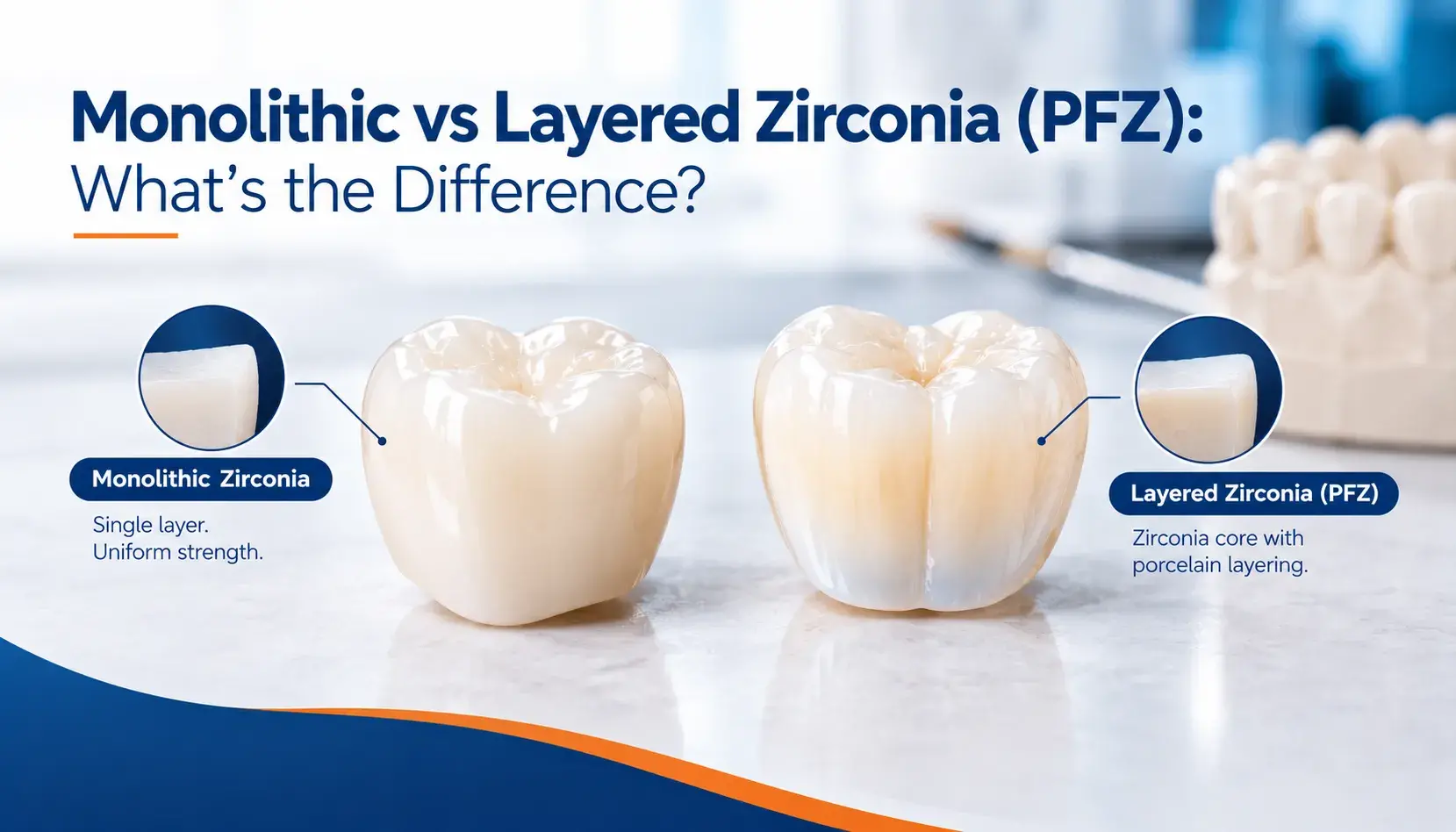
Monolithic zirconia is milled from a single blank and finished with surface stain and glaze. A layered restoration starts from a zirconia core that gets reduced back, then rebuilt in porcelain across multiple firings.
Same material underneath. Two different constructions. That one choice changes the clearance you need to prep, what the case costs, and how the restoration fails five years out.
Here is where each one belongs.
The Difference in One Minute
- Monolithic is one solid piece. Stronger at thin sections, cheaper, less lifelike.
- Layered carries porcelain built over a cutback core. Better optics, more reduction required, and a veneer that can chip.
- Five-year survival is close between the two. Chipping is not. Veneered designs chip significantly more often.
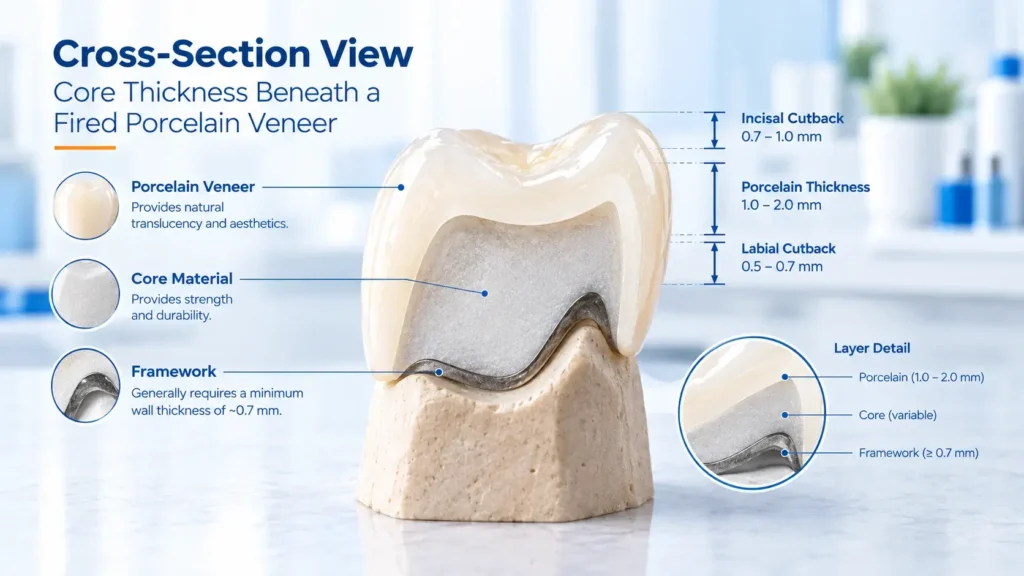
- An anterior cutback runs roughly 0.5 to 0.7mm labially and 0.7 to 1.0mm incisally, over a core that should stay at or above 0.7mm.
- Layering earns its cost in the aesthetic zone. Posteriorly it mostly adds a failure mode.
How Monolithic Zirconia Is Made
The restoration is milled oversized from a pre-sintered blank, then sintered down to final dimension, since zirconia shrinks predictably during firing. Colour and character are applied to the surface afterwards through stain and glaze.
Nothing is built on top. That matters more than it sounds, because there is no junction between two materials, and junctions are where bilayered restorations tend to give way.
It also works at sections no layered design can survive, which is why full-contour zirconia suits short clinical crowns, second molars, and heavy occlusal load.
The trade is optical. Stain sits on the outside rather than running through the restoration, so internal depth and incisal translucency are limited compared with layering. Higher-yttria generations narrow that gap, but they surrender flexural strength as translucency climbs.
How a Layered Crown Is Built
The technician takes a milled core and reduces it back to an anatomically shaped substructure, leaving room for porcelain. That porcelain then goes on in successive firings, each one building colour, translucency, and surface texture.
This is the ceramics side of a full-service lab, and it is the one department where the result is judged by eye rather than measured for fit.
Porcelain is simply the better aesthetic material. It accepts internal characterization and incisal effects that stain alone cannot reproduce. On a single central matched against a natural neighbour, the difference is visible across a room.
It also creates an interface. The research consistently identifies the veneer-to-core junction as the weak point in bilayered zirconia, driven by thermal expansion mismatch and residual stress left behind by the firing and cooling cycles.
How Much Cutback the Case Needs
This is where cases go wrong before the lab ever receives them.
Published anterior protocols use a labial cutback of roughly 0.5 to 0.7mm and an incisal cutback of 0.7 to 1.0mm, over a framework that manufacturers generally hold to a minimum wall thickness near 0.7mm. The porcelain itself performs best somewhere in the 1 to 2mm range.
Add those together and the arithmetic is unavoidable. A layered anterior unit wants meaningfully more tooth reduction than a monolithic one, where 0.7 to 1.25mm covers the entire restoration.
Two consequences:
The cutback has to be anatomic, not uniform. A core reduced to even thickness leaves porcelain unsupported over the cusps. Framework studies have repeatedly shown that copings shaped to support cusp form withstand higher loads before fracture, and produce smaller chips when they do fail.
Short clearance forces a bad choice. If the prep does not give the room, the lab either thins the core below its minimum or thins the porcelain until it is fragile. Neither is acceptable, which is why the call should come back to you instead.
How They Fail Differently
These two do not just fail at different rates. They fail in different ways, and that determines what happens next in your chair.
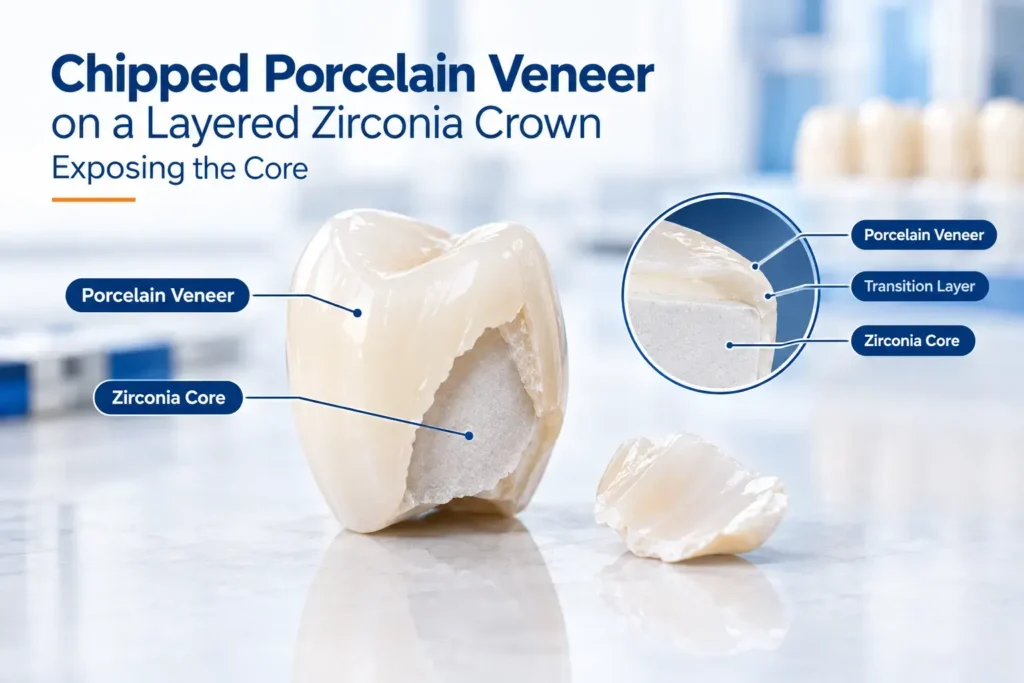
Layered zirconia chips. Porcelain fractures away from the core, usually leaving a thin film still bonded. Small chips can sometimes be smoothed and polished chairside. Larger ones go back to the lab or get remade.
Monolithic fractures in bulk, or not at all. There is no veneer to lose. When a monolithic unit does fail it tends to be a catastrophic fracture through the body, which is uncommon but not repairable.
The clinical data matches what technicians see on the bench. A systematic review of tooth-supported single crowns put five-year survival at 97.3% for veneered densely-sintered zirconia against 96.8% for monolithic, effectively level, while finding that monolithic showed significantly fewer ceramic fractures and chipping than veneered alternatives.
A larger meta-analysis covering 6,370 fixed prostheses landed in the same place: porcelain-veneered zirconia carried a higher rate of technical complications, and the gap was widest on minor and major chipping.
So survival looks similar. The maintenance burden does not.
The Two Compared
| Monolithic | Layered | |
| Construction | Single milled piece | Core plus fired porcelain |
| Minimum reduction | 0.7 to 1.25mm | Core plus 0.5 to 1.0mm cutback |
| Aesthetics | Surface stain and glaze | Internal characterization and depth |
| Dominant failure | Bulk fracture, rare | Veneer chipping |
| Chairside repair | Not practical | Small chips sometimes polishable |
| Best position | Posterior, bruxers, short crowns | Anterior aesthetic zone |
| Relative cost | Lower | Higher |
The Middle Option Most Prescriptions Miss
There is a third construction that almost never appears on a prescription: veneer the buccal surface only and leave the occlusal and lingual in full contour.
A five to ten-year retrospective study of implant-supported prostheses found that full-coverage veneered zirconia had a significantly higher chance of chipping than either buccal-only veneered or fully monolithic designs. You keep the optics where the patient sees them and the bulk strength where the load actually lands.
For a premolar visible in a broad smile, this is frequently the right answer. Write it on the prescription rather than leaving the lab to infer it.
When Layering Earns Its Cost
- Anterior units, especially a single central matched to a natural neighbour
- Cases where incisal translucency or internal characterization carries the result
- High aesthetic expectations paired with enough clearance to deliver on them
- Multiple anterior units where optical consistency across the segment matters
When Full Contour Is the Better Call
- Any posterior unit where porcelain would sit under direct occlusal load
- Confirmed bruxers. One retrospective study found significantly higher veneer chipping in bruxers than non-bruxers
- Short clinical crowns and limited interocclusal clearance
- Second molars, where access makes repair difficult and optics rarely matter
- Long-span bridges, where connector strength and passive fit outrank appearance
- Full-arch prostheses, where the same reasoning applies across the range of implant restorations a lab can make
Anteriorly with limited clearance, lithium disilicate is often a better answer than either zirconia option, since it delivers aesthetics at a thinner section.
Where Most Cases Land
For most practices the split is straightforward. Full contour posteriorly, layered anteriorly, buccal-only veneering for the premolars in between.
What actually decides the outcome is whether the prep supports the construction you asked for. Layered zirconia on short clearance is a chip waiting to happen, and no amount of technician skill repairs that after the fact.
Specify the construction on the prescription rather than leaving it open. If the clearance does not support what you asked for, expect a call.
American Dental Laboratory has built restorations in Richardson, Texas since 1986. To talk a material choice through before you prep, get in touch or call 972.276.5356.
Questions We Get Asked
Is a layered crown stronger than a monolithic one?
No. The zirconia core carries the strength in both, and layering adds a porcelain surface weaker than the core beneath it. Layering buys aesthetics, not strength.
Can a chipped veneer be repaired in the mouth?
Sometimes. Small chips that can be smoothed and polished chairside may be manageable. Larger ones exposing the core generally need lab repair or a remake.
Does full-contour zirconia wear the opposing teeth?
Well-polished zirconia is generally kind to opposing enamel. The wear problem comes from adjusted surfaces left unpolished, which is why repolishing after any occlusal adjustment matters.
How much reduction does each one need?
Monolithic works at roughly 0.7 to 1.25mm. Layered needs that core thickness plus 0.5 to 1.0mm of cutback for the porcelain, so plan for more.
What about PFM?
Both PFZ and porcelain fused to metal are bilayered, so both carry the same interface vulnerability. Published chipping incidence is comparable between them. The difference sits at the margin, not in the veneer.